The Impact of Implex
Key Takeaway: It is difficult to reduce the risk of idiopathic epilepsy, especially in breeds with small populations.
Implex, also known as pedigree collapse, occurs when the same dog(s) occupies too many places in the majority of pedigrees in a breed. In breeds with implex the genetic family tree collapses inward due to the loss of genetic diversity. The pedigrees of each dog branch outward as more and more generations are added, but the genetic diversity collapses. Implex is typically found in breeds with geographically isolated populations, breeds with very few breeding members and/or breeds where line breeding, inbreeding and popular sire syndrome occur regularly. Every breed has recessive genes that can cause health issues, but in breeds with large populations they cause fewer problems due to a higher volume of genetic diversity. In contrast, when dogs from populations with implex are bred, the resulting litters have a higher likelihood in receiving recessive genes via more than one path on the pedigree…so the probability of puppies inheriting recessive genes from both parents is greater. Breeding dogs that are closely related over time also increases the likelihood of recessive mutations occurring. Maybe idiopathic epilepsy existed when the Picardy was established as a breed, but more likely it is a result of recessive mutations or an outcross with a different breed that had epilepsy in its ancestry. We’ll never know for sure, but what we do know is that the Picardy Spaniel as a breed currently shows all the signs of implex…which is not good for the long-term health of any breed. Case in point. There are only ~2,000 Picardy Spaniels globally, and ~400 of those dogs reside in North America. Line- and inbreeding are the same thing from a genetic perspective, even though most of us think of them differently. Both are regular occurrences in our breed in Europe and North America. And, as with so many breeds popular sire syndrome is also a regular occurrence, sometimes out of necessity, sometimes by choice. And finally, only ~200 Picardy puppies are whelped annually. Given the average litter is ~8 puppies, that suggests that there are only ~40 to 50 active breeding dogs in any given year. This all may sound concerning, but it’s not uncommon in rare breeds.
Reminders
- There are 3 types of canine epilepsy, with Idiopathic Epilepsy being the most commonly diagnosed.
- Canine epilepsy, or seizure disorders, affect all breeds, including mixed breeds.
- No single dog is responsible for idiopathic epilepsy in their progeny.
- Currently there is no genetic test that can determine whether a dog carries the genes that cause idiopathic epilepsy.
Fast Facts
- Breeds with small populations have an increased risk of recessive genetic diseases occurring.
- Inbreeding and line breeding are the same thing from a genetic perspective.
- Inbreeding increases the risk of recessive genes aligning in a litter AND the probability that recessive genes will continue on in a breed for decades.
- Popular sire syndrome can significantly influence the genetic makeup and physical attributes of a breed for decades, if not longer.
- Implex, or pedigree collapse, is a result of short-term breeding decisions…planned and unplanned.
-read more-
Given implex, or pedigree collapse, is defined as the decline of genetic diversity in a breed it’s probably best to review the Coefficient of Inbreeding as COI is the most commonly used…and misused…measure of genetic diversity in most breeds. As a point of reference, a COI of 12.5% means that there is a 1-in-8 chance that a puppy will inherit 2 identical copies of a specific gene from a common ancestor on both sides of a pedigree…but that’s using 10-generations of ancestry. Using fewer generations artificially skews COI lower, which suggests that a breed or individual dog is genetically healthier than is actually the case. The following is an excerpt from our article: The COI Chronicles, published in the April 2023 North American Versatile Hunting Dog Association magazine. Link here
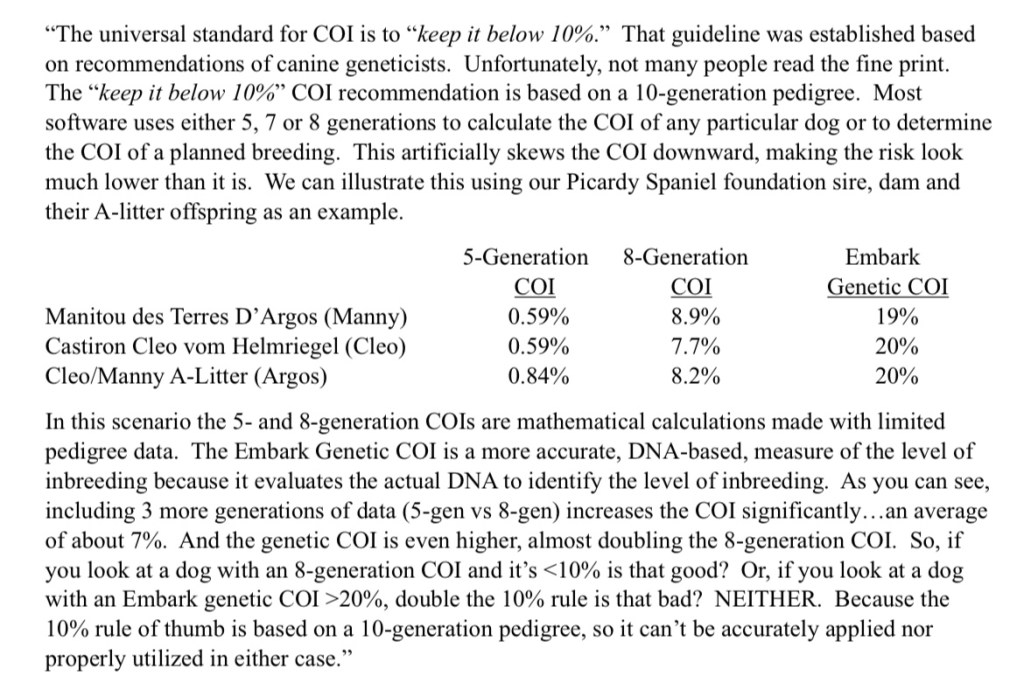
Most ‘purebred’ breeds have genetic COI’s that range from 20 – 25%. That’s the good news. The bad news is that a 25% genetic COI is the equivalent to breeding littermates, or a father to a daughter, something most of us would never do. Over time breeding dogs with 20 – 25% 10-gen COIs in small populations over time contributes to implex in a breed.
Another factor that creates implex in a breed is line breeding and inbreeding. We’ll discuss these two together because genetically they’re the same thing. Line breeding is usually thought of as the mating of two close relatives, but it’s more complicated than that. Breeding two first cousins or an uncle to a niece are one facet of line breeding, but so is breeding two dogs who share the same recent ancestors. In reality linebreeding is a planned form of inbreeding. In either case, the resulting puppies have a relatively high COI and the chances of recessive genes aligning increases, sometimes significantly. Line breeding is how many breeds were established, however…breeders mated related dogs because they had certain traits and line breeding is a way to perpetuate those traits. Their puppies…the ones who had the traits the breeder was looking for…were then bred, and eventually the offspring of these line breedings produced very similar dogs every time. The downside of linebreeding is that any genes for unfavorable traits…many of which are masked in the short-term…get hard wired into those bloodlines as well. And it takes generations and generations of very selective breeding to ‘breed out’ unfavorable genetics. Line breedings are still purposefully done today, and in moderation it’s not a bad thing. But when it’s done too often, or in a relatively high a degree in a small population it can quickly result in inbred dogs and implex. In breeds with high occurrences of linebreeding relative to the total population of dogs it may take decades for a gene pool to recover. Here’s an example of severe line breeding in Picardy Spaniels.
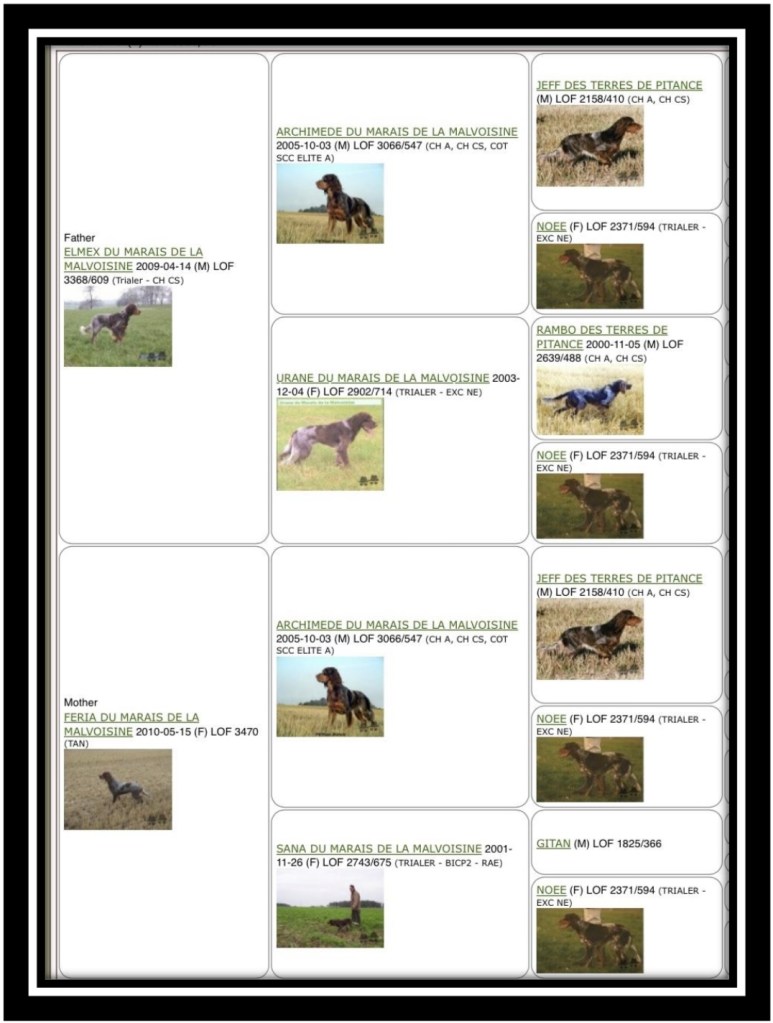
In this pedigree the same female occupies all 4 Great Grand Dam positions, and the same male occupies 2 of the 4 Great Grand Sire positions on this pedigree. The 8-generation COI for the litter sired by Elmex and Feria is 33%. You can find this pedigree in the Canine Central LOF Select as well. Their 5-generation COI is 24%.
Most breeds suffer from some measure of popular sire syndrome, which is the overuse of a male(s) in a breeding population. When just a few males dominate the breeding in a single breed, the breed will suffer long-term because overuse of a sire narrows the gene pool and future breeding options. The higher the number of appearances a single dog makes the greater the chance that recessive genes will be inherited by a puppies having that single dog repeatedly in both sides of their pedigree. Shortly after seeing how good Manny’s first litter of puppies turned out I thought it would be a great idea for him to sire 100 puppies…now I hang my head shamefully because he was still used too many times for a breed with such a small population. What constitutes overuse is defined in part by the total population of the breed. If Manny was a GSP, whose total population is ~100 times greater than that of Picardy Spaniels, his impact on the gene pool would be negligible. But that’s not the case, and Manny’s genetics will echo through the North American Picardy Spaniel gene pool for decades. Popular sire syndrome is not a new phenomenon, and the reason for it is typically one of the following:
- The stud is an excellent representation of the breed.
- There simply aren’t many stud dogs available.
- A breeder’s ego…sometimes referred to as ‘kennel blindness.’
- A lack of understanding of the long-term consequences of overusing a sire.
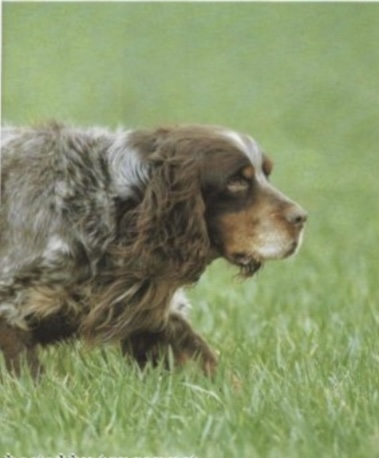
Pacha is an example of popular sire syndrome in Picardy Spaniels. Almost every 10-gen pedigree of Picardy Spaniels around the world has multiple occurrences of a sire named Pacha…a dog that was bred 10 times 40 years ago. Pacha appears in the pedigrees of the 4 most popular sires of the past decade multiple times. This means Pacha’s DNA will continue to reverberate through the breed for another 20 to 30 years.
- Manny – 51x
- Nox – 59x
- Iron – 30x
- Justus – 51x
The final facet of implex that impacts the Picardy Spaniel as a breed is its small population. This contributes to implex in 2 ways. First, the population is split geographically. There are ~2,000 Picardy Spaniels globally, but the regulations restricting the import of dogs to the US and also to Europe makes it very difficult to send dogs in either direction. So in effect there are 2 isolated populations, one of which is very small at ~400 dogs, and the other larger at ~1,600 dogs. Many geneticists suggest a population of ‘several thousand’ individual dogs is necessary to maintain the health of a breed. Secondly, and directly correlated, is reproduction rate. With ~200 Picardy puppies whelped annually, there are only ~40 to 50 active breeding dogs in any given year. There is a metric called the 50/500 Rule that geneticists use that indicates a population needs at least 50 breeding dogs to prevent serious implex in the short-term, and 500 breeding dogs to avoid long term genetic drift. This rule is a bit like COI, however, in that you need to read the fine print. IF the 50 dogs are not evenly split between sires and dams, the ‘50’ in that rule needs to increase to 55 or 60 or more, depending on the ratio of males to females. And even if the breeding population is split evenly, because such a small number of dogs are passing along their DNA their genes will determine the genetic makeup and physical attributes of the breed for decades. Further, if those 50 breeding dogs are closely related, the population becomes inbred.
As a breed the Picardy Spaniel has all the factors that lead to implex…and implex means that genetic diseases of all types become more common. Whether that’s why we are hearing more about idiopathic epilepsy in the breed or not is unclear. It could just as easily be that owners and breeders are becoming more transparent about cases because social media has brought us all closer. Whatever the case, there is some work to be done to help breeders make the best choices for the breed in the long term. All of the genetic complexities associated with idiopathic epilepsy combined with past breeding practices within the breed is why the next part of this series is entitled ‘A Breeder’s Conundrum…’
Spoiler Alert: Part VI: Improving Breeding Practices, will be posted on 05Jul26
Unfortunately we’ve had epilepsy in a litter of Picardy Spaniel puppies we’ve whelped, which is why we’ve decided to share the information we’ve uncovered about canine epilepsy. The publication of this series may be uncomfortable for some folks, but we are more concerned with the long-term health of our breed than about being politically correct. Our goal with this series on canine epilepsy is twofold.
- First, we want to share the information we’ve uncovered about canine epilepsy. Had we known a few years ago what we know now about canine epilepsy we would have made some different decisions with our dogs. Hopefully this series will help owners and breeders make more informed decisions about breeding and about the health of their dogs.
- Second, we want to figure out how best to minimize the risk of canine epilepsy in the Picardy Spaniel going forward. To try and achieve this goal we’re working with one of our puppy owners who is a biostatistician for a large US-based health care company. There is also a group in Europe that is working with a canine geneticist in Germany. We plan to share our data with the European group once we have run all the statistics and completed the pedigree modeling.
If you want to help, please email us directly if you own, have bred or otherwise know of a Picardy Spaniel that has epilepsy or has had seizures. Thank you in advance for your help. We not only need to be open and transparent about how great the Picardy Spaniel is, but also about any and all health issues if we are going to be good stewards of the breed. Our children, grand children, great grand children, etc. should be able to enjoy healthy Picardy Spaniels long after we’ve crossed the rainbow bridge.
Please feel free to email questions, comments and/or the names of any Picardy Spaniel affected by seizures to ricplath@gmail.com.
Reference Material Sourced From:
- University of Missouri Veterinary Health Center
- National Institute of Health (NIH)
- Cornell University College of Veterinary Medicine
- Tuft’s Canine and Feline Breeding Conference
- University of California – Davis
- Royal Veterinary College
- University of Manchester
- University of Helsinki
- University of Minnesota College of Veterinary Medicine
- Institute of Canine Biology
- My Epileptic Pet – Domes Pharma
- WebMd
- Genetics for Dog Breeders – Hutt
- Veterinary Partner
- Frontiers in Veterinary Science
- Double Helix Network News
Ric, Ellen and their Picardy Pack live in Westby, WI. A lifelong hunter, Ric has trained and hunted Small Munsterlanders, Gordon Setters, and for the past 10 years Picardy Spaniels. Ellen has an extensive background in animal genetics and a PhD in Reproductive Physiology. She bred and trained Greater Swiss Mountain Dogs prior to Picardy Spaniels.